Landscaping That Lasts: How Site Stabilization Turns a Finished Grade Into a Stable Landscape
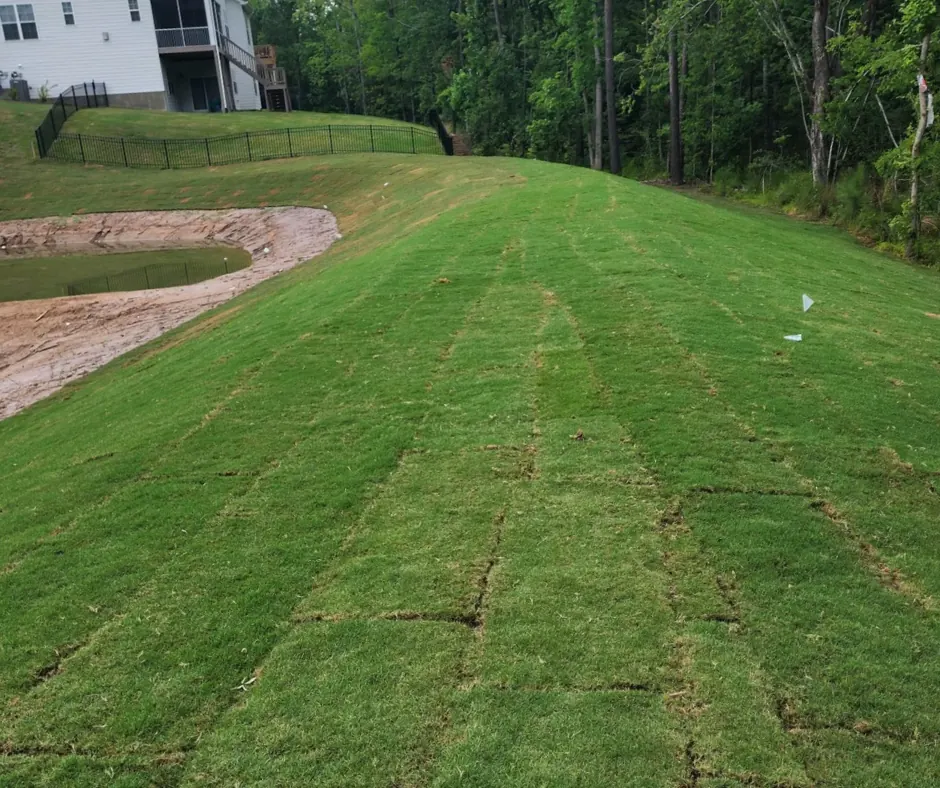
On a construction site, landscaping is not just the finishing touch that makes a project look done. It is the final layer of erosion control, the step that takes a bare, disturbed grade and turns it into a surface that actually holds. Get it right and the site stays stable through the first storms and the first seasons. Get it wrong and you are back out there fixing washouts and reseeding bare spots.
For developers and general contractors in North Carolina, understanding where landscaping and site stabilization overlap is one of the easiest ways to protect the investment at the end of a project.
Landscaping is the last line of erosion control
During active construction, you rely on physical measures: silt fence, matting, wattles, rip-rap. Those buy time. But the permanent solution for most disturbed ground is vegetation. Roots bind the soil, ground cover absorbs the impact of rain, and a healthy stand of grass or plantings is what keeps a slope in place for the long term.
That is why final landscaping and final stabilization are really the same conversation. The question is not just “does it look finished,” it is “will this surface still be here after a hard rain.”
Vegetative versus structural stabilization
Stabilization comes in two flavors, and most real sites need a mix of both.
Vegetative stabilization is seeding, sod and plantings. It is the go-to for slopes and open areas where you can establish cover. Sod gives you an instant, stable surface. Seeding is more economical over large areas but needs protection while it germinates.
Structural stabilization is matting, blankets, slope reinforcement, retaining walls and rock. It is what you use where vegetation alone will not survive: steep slopes, high-flow channels, and areas that take concentrated water.
The art is matching the two. A steep slope might get erosion control matting to hold the soil and seed while grass establishes underneath. A drainage channel might get coir matting with permanent seeding, or rip-rap where the flow is too strong for anything green.
What good site landscaping actually involves
Quality landscaping on a construction site is a sequence, not a single step:
- Site and soil prep. Grading to the right elevations, loosening compacted ground, and preparing a seedbed that will actually support growth.
- Choosing the right cover. Selecting the seed mix, sod type or plantings that suit the site’s sun, soil and slope.
- Installation. Laying sod tight with no gaps, drilling or broadcasting seed at the right rate, and pinning matting so it does not lift.
- Protection while it establishes. Matting, straw or mulch that keeps seed and soil in place until roots take hold.
- Watering and establishment. The unglamorous step that determines whether the whole effort survives its first month.
- Follow-up. Checking for bare spots, erosion and areas that need corrective work before they become a problem.
Sod that is laid tight and watered in will hold a slope almost immediately. Seed that is broadcast and forgotten will wash out with the first storm. The difference is process.
Landscaping and the environment
There is an environmental payoff to doing this well. Established vegetation does more than hold soil, it filters runoff, absorbs rainfall, and reduces the sediment leaving your site. In and around North Carolina’s growing communities, a finished landscape that is genuinely stable is also a finished landscape that protects the streams, ponds and neighborhoods downstream.
For pond conversions and stormwater areas, the vegetation is part of the system’s performance, not just its appearance. Matting and permanent seeding on pond slopes and floors are what make the finished basin resilient over the long term. You can see that combination in our project work.
Where it goes wrong, and how to avoid it
The most common landscaping failures on construction sites all come back to skipping steps:
- Seeding without protecting it, so it washes out.
- Laying sod on unprepared or compacted soil, so it never roots.
- Ignoring the slope, so vegetation that would survive on flat ground fails on the grade.
- Walking away before establishment, so the first dry spell or heavy storm undoes the work.
Avoiding all of it comes down to treating landscaping as the final stage of erosion control, with the same attention you gave the silt fence on day one. A team that handles both the erosion control and the final landscaping and stabilization under one roof is the simplest way to make sure nothing falls through the gap between “construction” and “finished.”
The bottom line
Landscaping is where a project either locks in its stability or quietly sets up its next round of repairs. Match vegetative and structural measures to the real slope and soil, prepare the ground properly, protect what you plant while it establishes, and check back before small problems grow. Done right, the landscape is not just the look of a finished site, it is the thing that keeps it finished.
Working on a site around Raleigh and the surrounding counties? Give us a call and we will help you plan a stabilization and landscaping approach that actually lasts.
Have a site that needs attention?
Delcid handles erosion control, stormwater, site stabilization, landscaping and street washing across North Carolina. The fastest way to reach us is a call.